
It’s Monday morning, and your team sends you a deck. You have 30 minutes to review it before you have to present it to your boss - and you know your team used AI to generate it. You don’t have time to review every number, but you can’t ensure the output is trustworthy.
This story isn’t uncommon. You might have experienced something similar yourself, and maybe you’ve gotten burned by a hallucinated figure or assumption.
Understandably, these stories make business leaders wary to lean into AI on an organizational level. It’s not just an optics problem: enterprise AI products should be built around trust and verifiability.
General-purpose chatbots weren’t built for this. ChatGPT and Claude are blunt instruments: they’ll take a swing at anything, and hand you an answer that takes time to manually verify. Finance work needs the opposite: a trustworthy tool built to produce durable, verifiable results.
That’s what we do at Summation.
Non-hallucinated content is the baseline
When a junior finance analyst is unsure about a given figure or projection, they will flag it to the team. When a generic LLM is unsure, there’s no guarantee it will flag an error.
More likely, it will generate an output that looks great, when in reality, the number or figure is completely invalid.
If a given model is 99% accurate, that 1% makes every finance and operations leader wary of adopting AI at all. The Summation platform is built to catch issues that you would otherwise miss, producing outputs you can trust.
Trace every number back to its source

When an AI makes a mistake, or when the numbers don’t tie out, can you tell? For us, making sure our outputs are accurate is a start: but unlike Claude or ChatGPT, we don’t ask you to blindly trust outputs.
Summation’s interface is built around transparency as one of its core values. Every metric, assumption, or calculation our AI analyst makes is checkable: not by asking the model again, but by hovering over the given figure and getting a direct preview of the source, derived from your data.
This is what we mean by auditability: you can click into any number and see exactly where the data comes from. It works hand in hand with verification, the checks we run behind the scenes to make sure the numbers are right in the first place. Verification is what we do for you. Auditability is what you can see for yourself.
Verification happens in layers
Up until this point, we’ve mostly been talking about single numbers. But a monthly close deck or a financial model don’t just consist of one number - they consist of networks of interdependent assumptions and calculations.
Numbers can each be correct and still contradict each other: different periods, different filters, different definitions. Individually right, collectively useless.
Numbers that are accurate in isolation aren’t always accurate in the scope of a report.
Our checks run bi-directionally: each figure against its source, and then the queries against each other, comparing periods, filters, entity scope, metric definitions. Consistency isn't a property of a number, it's a property of the whole set.
We think about verification as four layers. Each one answers a harder question than the last.
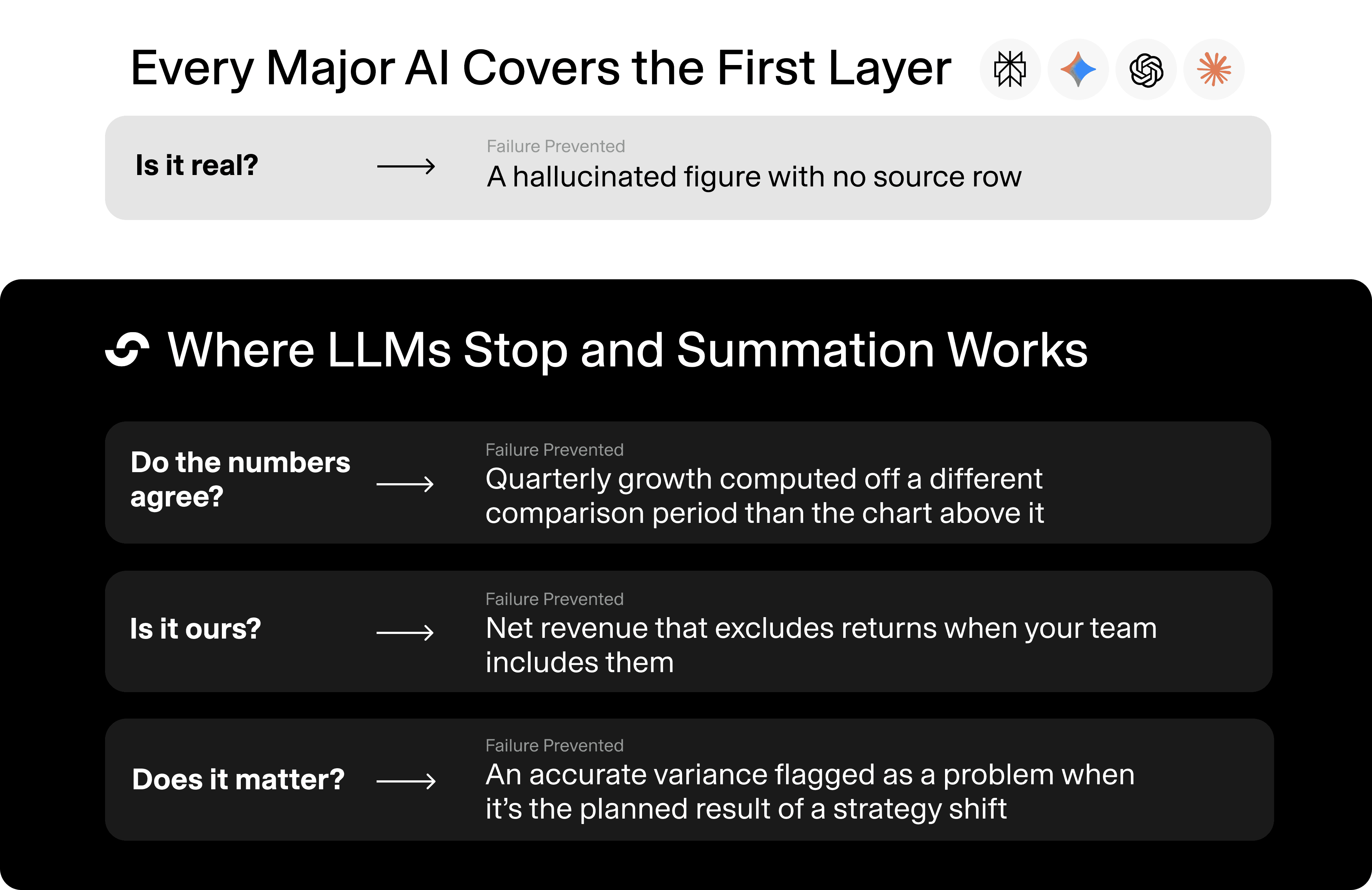
Most tools that mention citations stop at the first layer. Summation’s checks cover the first two, and we’re building tooling for the third and fourth: verifying that numbers are calculated with the definitions your team has set, and that analysis is presented with your business context and strategy in mind.
Our AI analyst iterates on reports until all of the checks pass, and surfaces any issues requiring your judgment. This workflow radically increases the capacity of a single human analyst. Cross-checking three thousand queries against each other is something nobody will ever do by hand - but Summation’s AI analyst does it in minutes.
And it doesn’t stop at analysis. Summation delivers the finished work: the close deck, the variance report, the forecast - verified, auditable, and ready to share. Not a wall of chat text to copy, reformat, and re-check by hand.
—
Jojo Chen is a Forward Deployed Product Manager at Summation. She has former experience in product management at Expedia and Deserve, and holds a bachelor’s degree in computer science and business from University of California, Berkeley
Stop guessing. Start improving.
The AI analyst that turns data into dollars.
Product
Trust
Account
Talk to us
© 2026 Summation Technologies, Inc.