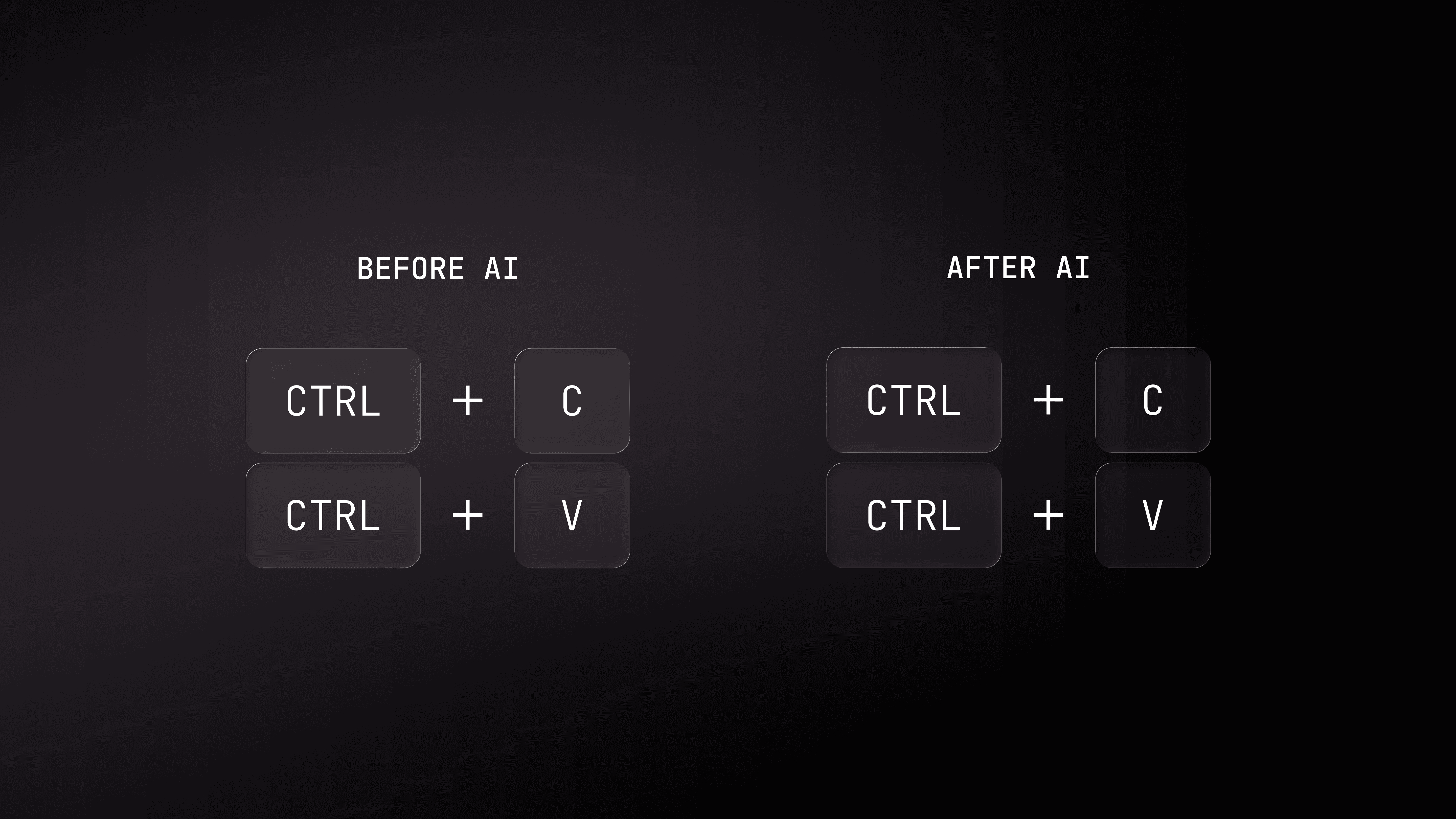
Most “analysis” still looks like assembly work: hunting for the right number, double-checking it, then Ctrl+C →Ctrl+V into whatever format the meeting needs. The output might inform a billion-dollar decision, but the process to produce it is often just manual data entry with better branding.
I saw it most clearly as Slack’s first BizOps hire. I built the corporate revenue model from scratch, and every week, I’d pull pipeline data from Salesforce. I would export CSVs, clean up formatting, and reconcile why my numbers didn’t match the version someone else pulled. Then I’d pour it all into the “Master Model”: a sprawling Excel file on a shared drive with seventeen tabs and years of logic that only two people fully understood. It was extraction, reformatting, and reconciliation every week before the real analysis could even begin. And then the analysis still had to happen in a room, in real time, in front of the CFO.
At Rippling, the tools got better. I learned SQL and connected Snowflake directly to our BI tool to automate dashboards. For a moment, it felt like I’d finally escaped the copy-paste era.
I hadn’t.
The queries still had to be written. Outputs still had to be formatted. Dashboards still had to be interpreted. The narrative still had to be constructed.
And every week, the same pattern repeated: someone asked a question the dashboard couldn’t answer. That meant another ad-hoc query, another export, another slide, another textbox to make the numbers legible.
The stack was more sophisticated, but the workflow was the same. Different decade, different tools. Same copy-paste at the end.
You bought AI, but you kept the copy-paste.
This isn't a talent problem. It's a structural one. And it's been hiding in plain sight.
AI doesn't fix a broken process. It inherits it.
When analytical output is too slow, the classic move is to hire more analysts. The modern move is to add AI. Neither fixes the underlying issue: fragmented data, inconsistent definitions, and manual reconciliation at every seam.
In that environment, AI doesn’t create clarity. It creates faster, more confident versions of the same incomplete picture.
So the uncomfortable question isn’t “Do we have AI?”, it’s: "What, exactly, is it reasoning against?"
And when the system can’t reliably turn raw signal into a decision-grade narrative, you encounter the Monday Morning Problem.
The Monday Morning Problem
Ian coined the term after watching the same thing happen everywhere: a weekly decision cadence built on a workflow that can’t keep up.
Amazon famously institutionalized the Weekly Business Review, a disciplined cadence where a team prepares a data-driven narrative each week. It is distributed before the meeting so discussion starts from a shared understanding rather than a deck being walked through live.
Most companies have a weekly review. Very few have the system behind it.
At Slack, ours was called “Call Your Number.” Wall Street guidance was on the line. The job wasn’t to present slides. It was to walk out of the room with a forecast everyone trusted.
Every week, the meeting started with the same question: “Why did the forecast change?”
I could answer that one. I built the model. I knew the inputs.
Then came the real questions, the ones the deck couldn’t immediately answer:
“Where is this number coming from?”
”Which segments are exposed?”
”What happens if enterprise deals keep slipping?”
By the end of the meeting, I’d have a notebook full of questions and zero time to think. The next 24–48 hours belonged to reconstructing answers: another export, another reconciliation, another slide, another narrative. And by the time I delivered the update, the calendar had already rolled forward. The next week’s meeting was coming whether or not the system was ready.
That’s the Monday Morning Problem: decisions are made on a cadence, but the truth arrives late because the workflow to turn data into a decision-grade narrative is still manual assembly.
Why we built Summation
Now I’m on the other side of the table at Summation, and this is the first place I’ve seen the cycle actually break. Not because we found a better prompt, but because we rebuilt the workflow underlying the decision. We unify the data, preserve the definitions, and make the narrative a first-class output rather than an afterthought.
When you close the gap between signal and narrative, a few things change immediately. Executives stop waiting for the deck and start interrogating the data directly. Weekly reviews shift from status updates to actual decisions. The questions get harder and more valuable because the infrastructure can keep up with them.
The companies gaining ground right now aren’t necessarily the ones with the best analysts or the biggest AI budgets. They’re the ones with the shortest cycle between something happening in the business and someone with authority knowing about it, then acting on it.
That cycle is compressible. Most organizations just haven’t treated it as a priority.
The question worth asking
Most organizations have already made the AI investment. The more important question is whether the organization’s decision system is built to turn that investment into better outcomes.
How quickly can you go from a real signal in the business to a decision that actually changes what happens next, including hiring, spend, pricing, targets, and priorities? If the honest answer is “days” (or “it depends on who’s around”), AI didn’t cause that lag. But it won’t eliminate it either.
The constraint isn’t intelligence. It’s latency: the time lost translating raw data into a coherent narrative that leadership can trust. When that translation depends on exports, reconciliations, and copy-paste, the truth arrives late. Meetings turn into arguments about the deck, not decisions.
The outcome to aim for is simple: a workflow where the narrative stays current, the numbers stay coherent, and the meeting is for decisions, not assembly.
That’s what Summation is built for.
—
Trevor Shih is Head of Business Operations at Summation. He joined Slack in 2015 as its first BizOps hire and led the team through its direct listing, then joined Rippling at Series A in the same role. He holds a BS in Business Administration from UC Berkeley's Haas School of Business.
Stop guessing. Start improving.
The AI analyst that turns data into dollars.
Product
Trust
Account
Talk to us
© 2026 Summation Technologies, Inc.